Yellow Level

1. Christine is a photographer

christine
This is Christine.

 Christine is a photographer. She’s been a professional photographer for the last three years. She works for a nature magazine and travels all over the world taking pictures of animals.

 To increase her chances of getting a good job, Christine went to college for four years and received a bachelor’s degree in photography. She also studied Spanish and French because she wanted to work in Spanish and French-speaking countries.

 Christine is also interested in making documentary films. She wants to spend a few months in a Colombian rainforest and make a film about the animals, insects, plants, and people that live there. She thinks filmmaking is one way to help save rainforests that are being destroyed.

Questions:

  • 1A: What does Christine do?
  • 1B: She’s a ____________.
  • 2A: Who does she work _____?
  • 2B: She works ______ a nature magazine.
  • 3A: How many years ______ she go to college?
  • 3B: She _______ for four years.
  • 4A: Which languages did she ________?
  • 4B: She studied Spanish and French.
  • 5A: What else is she interested in doing?
  • 5B: She’s interested in ________ documentary films.

(1. photographer; 2. for / for; 3. did / went; 4. study; 5. making)

Rabbit Problems

rabbit tracks
branches
owl
rabbit

rabbit tracks

damage to a bush

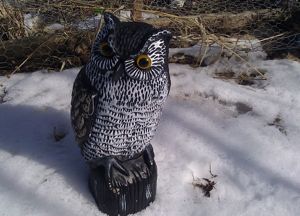
a plastic owl looks a little like the real thing

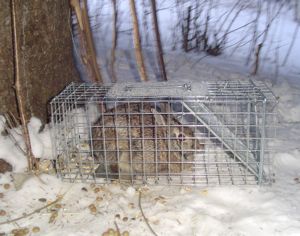
a trapped rabbit

Vocabulary

bark: the protective exterior for a tree or a bush.

droppings: a nice word for "poop" from an animal.

poultry wire: also called "chicken wire." This is used by gardeners and farmers to create a fence around gardens and trees to protect them from pests.

tracks: impressions in snow or the ground made by the feet of an animal.

Every winter after it starts to snow, I have a problem with rabbits. Normally, rabbits like to eat green grass and clover, but because there isn’t any of that to be found in the dead of winter, they go after the only source of food that’s available: bark.

In a desperate attempt to stay alive, rabbits have been eating the bark around the base of my apple trees and the beautiful bushes that surround my yard. This is very bad because the bark protects the trees from insects and harsh weather, and bark covers the live tissue that provides nutrients for the development of new growth in the spring. Stripping bark from a tree or a bush will eventually kill it.

On one hand, I feel sorry for the rabbits. All the tasty grass and clover that they usually eat is frozen and buried beneath the snow. They need food to survive, so they chew on the soft bark because that’s all they can find to eat. On the other hand, I don’t want to lose my trees and bushes, so I’ve done a few things to keep these furry little creatures away.

At first, I tried the most humane method of dealing with the problem. Last year, I gave the rabbits alfalfa (a dry grass that I bought at a pet store), believing that this would be a delicious alternative to my trees, but that just seemed to attract more rabbits. In the summer, there were baby rabbits everywhere.

Then, before the snow started to accumulate in the fall, I put poultry wire around the bushes and the trees that the rabbits were most likely to eat. Unfortunately, as the accumulation of snow on the ground grew higher, it became easier for the rabbits to reach the bark that remained uncovered. We’ve had a lot of snow this year, so the wire solution didn’t work out all that well.

I also put a plastic owl in the yard and moved it around to different places in order to fool the rabbits into thinking it was a real owl, but the rabbits quickly figured out that the owl was fake.

Finally, I tried to trap the rabbits with a live trap. The way it works is this: food is used as bait inside the trap. When the rabbit walks inside the cage, the door closes behind it, and then I drive the rabbit to an area far away and release it. I’ve caught a half dozen rabbits this way, but I’m not sure if this has made a difference.

Recently, however, it seems that nature has provided the ultimate solution. Although I live in an urban area, a couple of foxes have moved into the neighborhood, and everyone knows that foxes love to eat rabbits. I’ve also noticed the arrival of crows and hawks in my backyard. So now there are fewer rabbit tracks, and my trees are starting to look a little better than they did just a few months ago.

……………………………………………………………..

Now you try it. Read the paragraph above. If you have a microphone, you can record your voice and compare it to my voice.


Return to the Reading Room

Red Level

1. Stan likes to ride his bike

man riding a bike
man riding a bike

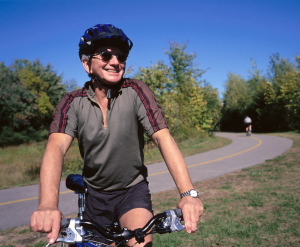
Stan likes to ride his bike. He rides to and from work every day, and he rides his bike on the weekend for recreation and fun. Sometimes he rides on a bike path, but more often he rides in the street along with regular traffic.

Stan wears a helmet for safety, and he always signals his turns when riding in traffic. He stretches his left arm out straight when making a left turn, and he stretches his right arm out straight when making a right turn. State law in Minnesota requires that people on bikes ride on the right-hand side of the road. Also, according to state law, drivers of cars must give bicyclists at least three feet of space when passing.

^ ^ ^ ^ ^ ^ ^ ^ ^ ^ ^ ^ ^ ^ ^ ^ ^ ^ ^ ^ ^ ^

Now you try it. Read the paragraph above. If you have a microphone, you can record your voice.

How much do you remember from the reading? Fill in the blanks.  

  • 1A: What does Stan ride to work?
  • 1B: He _____ a bike.
  • 2A: What _____ he wear to keep safe?
  • 2B: He wears a helmet.
  • 3A: Which arm does he use for a left turn?
  • 3B: He _____ his left arm.
  • 4A: On what side of the road do people ride their bikes?
  • 4B: They _____ on the right-hand side.
  • 5A: How much room must drivers give to people who ride bikes on the street?
  • 5B: They must give at least three ______.

(1. rides; 2. does; 3. uses; 4. ride; 5. feet)

1. The Man, the Boy, and the Donkey

man boy donkey
man boy donkey

Vocabulary

youngster: a young person

lout: an oaf or a rude person; a person whose behavior is bad. (this is not a popular word in the U.S.)

passers-by: people who walk or drive past someone

jeer: to criticize someone

struggle: fight; physical resistance

drown: to die in the water

please: to make someone happy (use of this word as a verb is quite different from its use as a polite request.)

A man and his son were once going with their donkey to market. As they were walking along by its side, a countryman passed them and said: “You fools, what is a donkey for but to ride upon?”

So the man put the boy on the donkey and they went on their way. But soon they passed a group of men, one of whom said: “See that lazy youngster, he lets his father walk while he rides.”

So the man ordered his boy to get off, and got on himself. But they hadn’t gone far when they passed two women, one of whom said to the other: “Shame on that lazy lout to let his poor little son trudge along.”

Well, the man didn’t know what to do, but at last he took his boy up before him on the donkey. By this time they had come to the town, and the passers-by began to jeer and point at them. The man stopped and asked what they were scoffing at. The men said: “Aren’t you ashamed of yourself for overloading that poor donkey of yours and your hulking son?”

The man and boy got off and tried to think what to do. They thought and they thought, till at last they cut down a pole, tied the donkey’s feet to it, and raised the pole and the donkey to their shoulders. They went along amid the laughter of all who met them till they came to Market Bridge, when the donkey, getting one of his feet loose, kicked out and caused the boy to drop his end of the pole. In the struggle the donkey fell over the bridge, and his fore-feet being tied together he was drowned.

“That will teach you,” said an old man who had followed them:

Please all, and you will please none

Baseball

pitcher
batter
baseball bat
catcher
fielder
baseball stadium

A pitcher throws a ball towards the batter.

A batter tries to hit the ball.

A batter uses a bat to the hit the ball.

A catcher sits behind home plate and catches the ball thrown by the pitcher. The pitcher and the catcher are the busiest players on a baseball team.

A fielder plays a defensive position.
Baseball is played inside a baseball park. The game is played on a field.

Vocabulary

bat: a long piece of wood used to hit a baseball.

inning: a period of play in basebll. Each team has an opportunity to score runs in each inning. There are nine innings in a game.

run: a point

strike: a missed opportunity to hit a baseball; three strikes result in an out.

pitcher
batter
baseball bat
catcher
fielder
baseball stadium

Baseball is America’s national past time. It’s played by both professional and amateur players during the spring, summer, and fall. Almost anyone of any size or ability can play baseball, which is why it’s a very popular sport among children and adults.

Baseball is played on a field between two teams. Each team tries to score runs by hitting a baseball and advancing runners around four bases: first base, second base, third base, and home plate.

Each team has at least three opportunities within an inning to get players on base. If a player is unsuccessful as a batter or as a runner on base, he or she is out. Each team is allowed three outs per inning. After three outs, the teams switch positions. The team that was batting goes to the field to play defense, while the team that was on the field, gets its turn to bat and score runs.

There are nine players on each team: the pitcher, catcher, first baseman, second baseman, shortstop, and third baseman play in the infield, while the right fielder, center fielder, and left fielder play in the outfield. The infielders and outfielders try to prevent batters on the opposing team from scoring runs. (A "run" is a point, but don’t use the word "point" in baseball!)

The main action takes place in the infield. A pitcher throws a ball to the catcher as the batter from the other team tries to hit the ball. A thrown ball is called a pitch. If a pitch is good, it can be counted as a strike if the batter doesn’t hit it. If a pitch is bad, it’s counted as a ball. Each batter is limited to three strikes and four balls. The umpire is similar to a referee. He makes decisions about whether or not a pitch is good.

Baseball is a little confusing until you know the rules and have watched a few games; however, if you are interested in American English, it’s a good idea to learn a few things about how baseball is played.

1. The United Nations Headquarters is in New York City

united nations

The United Nations headquarters* is in New York City. It was built in 1949. The land for the building was donated by John D. Rockefeller, and the construction of the building was financed by the United States government. Although the building is in New York City, the land that it occupies is considered to be international territory.

Inside the U.N. Headquarters is the United Nations Organization. It was founded in 1945 and it’s made up of 192 member states. This organization is designed to help prevent the outbreak of conflicts between nations; it also helps provide support for people around the world who are affected by natural and human-made disasters.

United Nations offices are also located in Geneva, Vienna, and Nairobi.

English and French are the two primary languages that are spoken inside the headquarters, but because almost every country around the world is represented inside the building, it’s not hard to find people who speak other languages.

Check your understanding:

  • 1A: When was the United Nations Headquarters built?
  • 1B: It ____ ______ in 1949.
  • 2A: In what year was the United Nations Organization founded?
  • 2B: It _____ ______ in 1945.
  • 3A: What are the two primary languages spoken inside the building?
  • 3B: Primarily English and French _____ _______.
  • 4A: How many member states are there in the U.N.?
  • 4B: There are _______ member states.

* The word "headquarters" can be either singular or plural. Because the word describes one main location, the singular is used in the reading selection.)

(ANSWERS: 1. was built; 2. was founded; 3. are spoken; 4. 192)

2. This is a young married couple

couple
lelft

This is a young married couple. His name is John. Her name is Jennifer. They live in a house in Alexandria, Minnesota. He works as a carpenter. She works at a diner as a waitress. They are very happy together, and they enjoy their lives.

O O O O O O O O O O O O O O

Now you try it. Read the paragraph above. If you have a microphone, you can record your voice and compare it to my voice.

write by hand

  How much do you remember from the reading? Fill in the blanks.

  • A: Do they live in a house or an apartment?
  • B: They live _____ a house.
  • A: What city do they live in?
  • B: They live _____ Alexandria.
  • A: What state do they live in?
  • B: They live _____ Minnesota.

The answer for each sentence is "in."